The Indian rupee rebounded 50 paise from its all-time closing low to settle at 96.36 against the US dollar, driven by retreating crude oil prices, signs of easing geopolitical friction, and likely central bank intervention.

Indian stock markets extended their gains for a second consecutive session, with the Sensex closing 736 points higher, driven by a global equity rally and a significant drop in crude oil prices following the finalisation of a peace deal between the US and Iran to end their 107-day conflict and reopen the Strait of Hormuz.
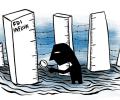
India's foreign direct investment (FDI) inflows are projected to surpass $90 billion in 2025-26 (FY26), driven by robust policy reforms, free trade agreements, and strong economic growth, according to DPIIT Secretary Amardeep Singh Bhatia.

After three consecutive months of heavy selling, foreign portfolio investors (FPIs) turned net buyers in the first week of February, infusing more than Rs 8,100 crore in Indian equities, aided by improving risk sentiment, along with a trade deal with the US.

'I don't see fear becoming a dominant factor for retail investors.'

Your children may always love you but should you expect them to to finance your retirement in today's economy?

Foreign Portfolio Investors (FPIs) have withdrawn nearly Rs 43,000 crore from Indian equities in the first week of June, contributing to a total outflow of Rs 2.67 lakh crore in 2026, driven by a global shift towards technology and AI-linked opportunities and persistent rupee depreciation.

The Indian rupee weakened against the US dollar due to geopolitical tensions surrounding the Strait of Hormuz and ahead of the Reserve Bank of India's monetary policy review.

For the foreseeable future, the most likely outcome remains continuation of the status quo. Taiwan will remain self-governing without formally declaring independence, while China continues to apply sustained pressure short of war, predict Krishnan Srinivasan and Manoj Mohanka.
Currently, the five-year FTP aims to raise total exports to $900 billion but targets may be reduced

The Indian government informed Parliament that India and the US are engaged in negotiations for a mutually beneficial multi-sectoral bilateral trade agreement. The two countries also cooperate on strategic, economic, and defense matters, managing divergences through high-level dialogues.

External Affairs Minister S Jaishankar has strongly defended India's decision to purchase Russian crude oil, stating that the country's energy choices are based on cost and availability, and highlighting the West's 'hypocrisy' in criticising India while historically supplying weapons used against it.

India is among six countries on the priority watch list in a US report addressing the protection and enforcement of intellectual property rights.

Indian investors have seen their wealth erode by a staggering Rs 16.77 lakh crore over four trading sessions, as the markets faced deep losses driven by elevated crude oil prices, geopolitical tensions, persistent foreign fund outflows, and a record-low rupee.

Strong domestic growth will continue to draw foreign investment into the Indian economy, Reserve Bank of India (RBI) Governor Sanjay Malhotra said on Tuesday. He said this was reflected in recent free trade agreements and investment commitments by large technology companies.

The Quad grouping has expanded cooperation in critical minerals and energy, while unveiling new measures to boost maritime surveillance and port infrastructure across the Indo-Pacific. This move comes against the backdrop of China's growing military posturing in the region, with ministers reiterating strong opposition to destabilising actions and expressing serious concerns over militarisation of disputed features.
The central bank is yet to consider actions such as a rate hike or mobilising dollar inflows from non-resident Indians to boost forex reserves as it cannot afford to continue with them for long when the rupee's internationalisation tops its agenda, explains Tamal Bandyopadhyay.

Sharp differences between Iran and the UAE over the West Asia conflict were on full display during the BRICS foreign ministers' meeting in New Delhi, signalling the challenges the bloc faces in reaching a consensus position on the crisis.

Donald Trump said he will never sign any trade agreement that hurts US workers, or diminishes its freedom and independence.

US President Donald Trump will visit China from May 13 to 15 at the invitation of President Xi Jinping. The visit occurs amidst global tensions, including the war in West Asia and trade disputes between the US and China. Discussions are expected to cover China-US relations, world peace, and economic issues.

Donald Trump agreed with Xi Jinping's assessment of the US as a 'declining nation,' but attributed the decline to the policies of the Biden administration.

The Indian rupee depreciated 20 paise to close at a fresh all-time low of 94.88 against the US dollar, driven by surging Brent crude oil prices, hovering around USD 115 per barrel, and persistent foreign capital outflows.

'Nepal today is far more aware, self-confident, aspirational, and assertive.' 'India's policy so far has not been geared to this shift. It is time to redraw our Nepal strategy.'

If Iran and Oman choose to charge a fee for rendering services to vessels using their territorial waters, so be it. The US is indulging in an irrationally self-destructive act, notes Ambassador M K Bhadrakumar.

Indian equities on Dalal Street saw volatility as global market trends and fresh tariff concerns linked to Donald Trump impacted investor sentiment. Track Sensex, Nifty50 movement and key market drivers for Feb 24, 2026.

Reserve Bank of India (RBI) Governor Sanjay Malhotra stated that preventing second-round effects of supply shocks, where inflation expectations rise due to prolonged disruptions, is the primary role of monetary policy. He also defended the RBI's foreign exchange market interventions, asserting it did not commit to an 'indefensible peg'.

Indian benchmark stock indices, Sensex and Nifty, closed nearly 1 per cent lower due to surging crude oil prices, weak global market trends, and significant foreign fund outflows, with geopolitical tensions and inflation concerns further dampening investor sentiment.

China's Foreign Ministry has refuted allegations of providing military support to Iran, warning the US against imposing tariffs based on these accusations. The statement follows reports of Iran acquiring a Chinese satellite for targeting US military bases. Meanwhile, a rescheduled meeting between Presidents Trump and Xi Jinping is set for May.

India is closely monitoring Sri Lanka's decision to offer foreign investors control of an airport near the China-controlled Hambantota port, as it could present a rare opening for Indian firms seeking strategic footholds in the Indian Ocean.

The Confederation of Indian Industry (CII) has proposed a 20-point policy agenda to the finance ministry, including a conflict-linked emergency credit line guarantee scheme and tax rationalisation on energy inputs, to support MSMEs, exporters, and energy-intensive industries affected by the ongoing West Asia war.

The rupee slumped 5 per cent in 2025 as persistent capital outflows from foreign investors, alongside heightened dollar demand from importers, making it one of the worst-performing Asian currencies.

Israel's Defence Minister Israel Katz declared that the Israeli military will not withdraw from its security zones in Lebanon, Syria, and Gaza, directly opposing the newly announced American-led diplomatic framework with Tehran. National Security Minister Itamar Ben-Gvir further asserted Israel's sovereignty, stating, "Trump's agreement does not bind us. Israel is not subject to the United States, and we are an independent and sovereign nation!"

The establishment had permission for only six rooms under the Delhi government's bed-and-breakfast policy but was allegedly operating around 25 rooms, including some in the basement, police sources said.

WPI inflation data, trading activity of foreign investors and global cues would dictate trends in the stock market this week, analysts said.

India emerged reasonably well from 2025. But now, the oil shock and war-related supply disruptions have again driven funds out of India and significantly weakened the rupee, points out Ajay Chhibber.

The Indian rupee saw a significant appreciation against the US dollar following President Trump's suspension of military strikes against Iran and the Reserve Bank of India's decision to maintain its key interest rate. Market sentiment was further buoyed by positive comments from the RBI regarding the health of the banking sector.

Reserve Bank of India (RBI) Governor Sanjay Malhotra stated that recent regulatory measures to address foreign exchange market volatility, such as capping banks' net open positions, are temporary and aligned with current market conditions, not signalling any structural shift in policy.

Russian President Vladimir Putin asserted that any attempts to undermine India's sovereignty through 'threats of sanctions' would 'boomerang immediately' under Prime Minister Narendra Modi's leadership, highlighting India's sovereign decision-making and strong national interests.

Indian equity benchmark indices, Sensex and Nifty, tumbled nearly 2 per cent for the fourth consecutive session, driven by elevated crude oil prices, escalating US-Iran tensions, unabated foreign fund outflows, and a depreciating rupee.
Indian equity benchmark indices, Sensex and Nifty, tumbled nearly 2 per cent for the fourth consecutive session, driven by elevated crude oil prices, escalating US-Iran tensions, unabated foreign fund outflows, and a depreciating rupee.
